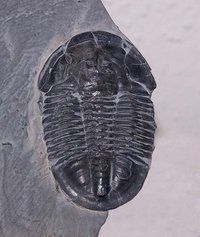
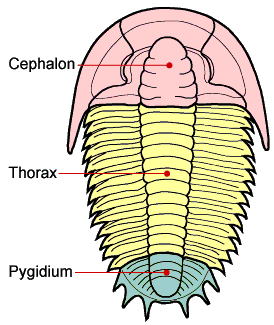
The bodies of trilobites are divided into three parts (tagmata): a cephalon (head), composed of the two preoral and first four postoral segments completely fused together; a thorax composed of freely articulating segments; and a pygidium (tail) composed of the last few segments fused together with the telson. In the most primitive trilobites the pygidia are still fairly rudimentary. The thorax is fairly flexible—fossilised trilobites are often found curled up like modern woodlice for protection.
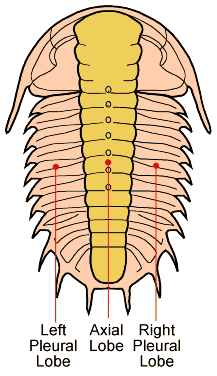
Trilobites had a single pair of preoral antennae and otherwise undifferentiated biramous limbs. Each exopodite (walking leg) had six segments, analogous to those of other early arthropods. The first segment also bore a feather-like epipodite, or gill branch, which was used for respiration and swimming. The limbs were covered by lateral projections called pleural lobes, extending outward from a central axial lobe. Contrary to popular belief, it is this longitudinal tripartite division into left and right pleural lobes and a central axial lobe that gives trilobites their name, not the division into cephalon, thorax and pygidium.
Although trilobites were only armored on top, they still had a fairly heavy exoskeleton. During moulting, the exosekelton generally split between the head and thorax, which is why so many trilobite fossils are missing one or the other: many trilobite fossils are actually moulted exoskeletons rather than dead trilobites. In most groups there were two facial sutures on the cheeks to make shedding easier. The cheeks usually also supported a pair of crescent-shaped compound eyes, which were surprisingly advanced in some species. In fact, trilobites were the first animals to evolve true eyes, about 543 million years ago; the evolutionary appearance of eyes has been postulated as a trigger for the Cambrian Explosion.
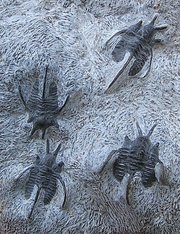
Some trilobites such as those of the order Lichida evolved elaborate spiny forms, particularly during the Devonian period. Examples of these specimens have been found in the Hamar Laghdad formation of Alnif in Morocco. These spiny forms could possibly have been a defensive response to the evolutionary appearance of fish.
According to "New Scientist" magazine (May 2005), "some... trilobites... had horns on their heads similar to those of modern beetles." Based on the size, location, and shape of the horns, Rob Knell, a biologist at Queen Mary University of London and Richard Fortey of London's Natural History Museum, concluded that the most likely use of the horns was combat for mates, making trilobites the earliest exemplars of this behavior. While this study only covered the raphiophorid family, the conclusions can be applied to other groups as well, such as the Walliserops trifurcates
Trilobites range in length from one millimetre to 70 cm (1/25 inch to 20 inches), with a typical size range of two to seven centimetres (1 to 3 1/2 inches).
Sensory organs
Many trilobites had eyes and they had antennae that perhaps were used for taste and smell. Some trilobites were blind, probably living too deep in the sea for light to reach them. Others, such as Phacops rana, had eyes that were quite large.
The eyes of trilobites were made of calcite (calcium carbonate, CaCO3). Pure forms of calcite are transparent, and the trilobites used clear calcite crystals to form the lenses of their eyes. In this, they differ from most other arthropods, which have soft eyes. The trilobite eyes were typically compound, with each lens being an elongated prism. The number of lenses in such an eye varies, however: some trilobites had only one so they could only distinguish between light and dark, and some had thousands of lenses in one eye. In these compound eyes, the lenses are arranged hexagonally. A living species with similar eyes is the brittle star Ophiocoma wendtii.
Holochroal eyes
Holochroal eyes had a great number of (tiny) lenses (up to over 15000), and are found in all orders of trilobite. These lenses were packed closely together (hexagonally) and touched each other. A single corneal membrane covered all lenses. These eyes had no sclera, the white layer covering most current eyes.
Schizochroal eyes
Schizochroal eyes typically had less (and larger) lenses (to around 700), and are found only in Phacopida. The lenses were separate, with each lens having an individual cornea which extended into a rather large sclera.
Abathochroal eyes
Abathochroal eyes had few (and small) lenses (to around 70), and are found only in Cambrian Eodiscina. Each lens was separate and had an individual cornea. The sclera was separate from the cornea, and did not run as deep as the sclera in schizochroal eyes.
Development
An egg hatched to give a tiny larva called a protaspid, in which only the fused segments of the cephalon are present. Subsequent thoracic segments were added behind the cephalon in successive molts during an intermediate stage called meraspid, until finally the adult number of segments was reached, at which point the animal is called a holaspid. Trilobite larvae are reasonably well known and provide an important aid in their classification.
Terminology
When describing differences between different taxa of trilobites, the presence, size, and shape of the cephalic features above are often mentioned.
Figure 1 shows gross morphology of the cephalon. The cheeks (genae) are the pleural lobes on each side of the axial feature, the glabella. When trilobites molt or die, the librigenae (the so-called "free cheeks") often separate, leaving the cranidium (glabella + fixigenae). Figure 2 shows a more detailed view of the cephalon.
Read more at Wikipedia.org



 Contact
 Home
Home Ant
Ant