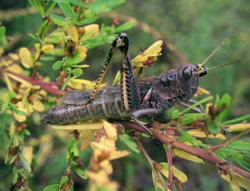
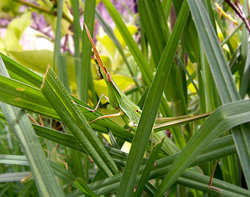
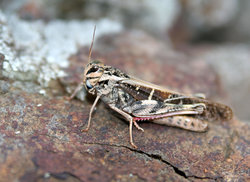
Caelifera is a suborder of herbivorous insects of the order Orthoptera, commonly called grasshoppers or locusts in English, the sub-order includes short-horned grasshoppers, grasshoppers and locusts.
Characteristics
The Caelifera have antennae that are shorter than the body, and short ovipositors. Those species that make easily heard noises usually do so by rubbing the hind femurs against the forewings or abdomen, or by snapping the wings in flight. Tympana, if present, are on the sides of the first abdominal segment. The front femora are long and strong, fitted for leaping. Generally they are winged, but hind wings are membranous while front wings (tegmina) are coriaceous and unfitted for flying. Females are normally larger than males, with short ovipositors.
They are easily confused with the other sub-order of Orthoptera, Ensifera. In fact up to few years ago both sub-orders were classified together in the order of Orthoptera, but are different in many aspects, such as the number of segments in their antennae and ovipositor. Ensiferans have antennae with at least 30 segments, and caeliferans have less. In evolutionary terms, the split between the Caelifera and the Ensifera is not more recent than the Permo-Triassic boundary (Zeuner 1939).
Taxonomically, Borror and White (1970) note that the hind femora are usually enlarged, tarsi have three segments or less, antennae are relatively short, tympana are usually present on the sides of the first abdomenal segment, and the ovipositor is short. Taxonomic descriptions of the families are more specific.
Diversity and range
Recent estimates (Kevan 1982; Günther, 1980, 1992; Otte 1994-1995; subsequent literature) indicate some 2,400 valid Caeliferan genera and about 11,000 valid species described to date. Many undescribed species exist, especially in tropical wet forests. The Caelifera are predominantly tropical but most of the superfamilies are represented world wide.
Families
The Sub-Order consists of five major families:
- Acrididae (grasshoppers and short-horned grasshoppers)
- Eumastacidae (monkey grasshoppers)
- Tanaoceridae (tanaocerids)
- Tetrigidae (grouse locusts, pygmy grasshoppers, and pygmy locusts)
- Tridactylidae (pygmy mole crickets)
The most important family is Acrididae, consisting of about 10,000 species. The family is characterised by the adults wings and legs, which are well developed and may be brightly coloured. As well as singing by rubbing their legs together, there may also be a visual display. The Acrididae family includes the Locust, which can be a serious economic pest.
Eggs are laid in the ground with a foamy substance around them to protect them during incubation; typically the number of eggs laid by a female is between 400 and 500.
Biology
Digestion and excretion
The digestive system of insects includes a foregut (stomodaeum - the mouth region), a hindgut (proctodaeum - the anal region), and a midgut (mesenteron). The mouth leads to the muscular pharynx (which sucks and swallows), and through the esophagus to the crop. This discharges into the midgut, which leads to the malpighian tubules. These are the chief excretion organs. The hindgut includes intestine parts (including the ileum and rectum), and exits through the anus. Most food is handled in the midgut, but some food residue as well as waste products from the malpighian tubules are managed in the hindgut. These waste products consist mainly of uric acid, urea and a bit of amino acids, and are normally converted into dry pellets before being disposed of.
The salivary glands and midgut secrete digestive enzymes. The midgut secretes protease, lipase, amylase, and invertase, among other enzymes. The particular ones secreted vary with diet.
Nervous System
The grasshopper's nervous system is controlled by ganglia, dense groups of nerve cells which are found in most animals more advanced than cnidarians. In grasshoppers, there are ganglia in each segment as well as a larger set in the head, which are considered the brain. There is also a neuropile in the centre where all of the ganglia channel signals through. The sense organs (sensory neurons) are found near the exterior of the body and basically consist of tiny hairs (sensilla), made up of one sense cell and one nerve fibre, which are each specially calibrated to sense a certain thing. While the sensilla are found all over the body, they are most dense on the antennae, palps (part of the mouth), and cerci (near the posterior end). Grasshoppers also have tympanal organs for sound reception; both these and the sensilla are linked to the brain via the neuropile.
Reproduction
The grasshopper's reproductive systems consists of the gonads, the ducts which carry sexual products to the exterior, and accessory glands. In males, the testes are made up of a number of follicles which hold the spermatocytes as they mature and form packets of elongated spermatozoa. After they are liberated in bundles, these spermatozoa accumulate in the vesicula seminalis (vas deferens).
In females, each ovary is made up of ovarioles. These converge upon the two oviducts, which unite to create a common oviduct which carries ripe eggs. Each of the ovarioles is made up of a germarium (a mass of cells that form oocytes, nurse cells, and follicular cells) and a series of follicles. The nurse cells nourish the oocytes during early growth stages, and the follicular cells provide materials for the yolk and make the eggshell (chorion).
During reproduction, the male grasshopper introduces sperm into the vagina through its aedeagus (reproductive organ), and inserts its spermatophore, a package containing the sperm, into the female's ovipositor. The sperm enters the eggs through fine canals called micropyles. The female then lays the fertilized egg pod, using her ovipositor to insert the eggs about one to two inches underground, although they can also be laid in plant roots or even manure. The egg pod stays there through the winter, and hatches when the weather has warmed sufficiently. The first nymph to hatch tunnels up through the ground, and the rest follow. Grasshoppers develop through stages that progressively get larger in body and wing size. This development is referred to as hemimetabolous or incomplete development.
Read more at Wikipedia.org



 Contact
 Home
Home Ant
Ant